









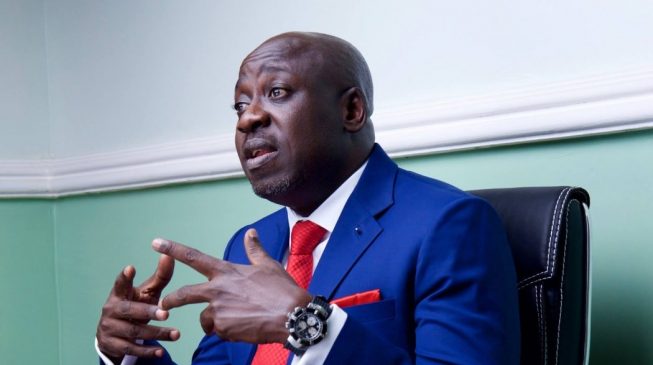

The National Publicity Secretary of the African Democratic Congress (ADC), Bolaji Abdullahi, has criticised former presidential aspirant Peter Obi, accusing him of showing limited commitment to the party’s ideological framework before his exit.
Obi, alongside Rabiu Kwankwaso, announced his departure from the ADC on Sunday, citing a protracted leadership crisis within the party as the reason for joining the Nigeria Democratic Progress (NDP).
However, speaking during a Prime Time interview on ARISE Television, Abdullahi dismissed the justification, arguing that Obi was never deeply engaged with the party’s policy direction despite efforts to build a comprehensive manifesto.
“We set up a manifesto committee that worked for about two to three months to develop a document that clearly outlined what we will do differently,” Abdullahi said.
Questioning Obi’s grasp of the party’s positions on key national issues, he added: “You may invite His Excellency Peter Obi here and ask him, what is the ADC position on fuel subsidy? What is the ADC’s framework on security? He doesn’t know, because he’s never been interested.”
Abdullahi further alleged that some politicians prioritise securing party tickets over engaging with ideological principles.
“They are just waiting for the tickets to be handed to them. If you say you want to contest election, and you believe in changing the country, you should know what your party stands for,” he added.
Defending the ADC’s structure, the spokesman described the party as ideologically grounded and positioned to offer credible alternatives, but warned that certain actors treat political platforms as vehicles for personal ambition.
“Everything that the government has thrown at the ADC, we have resisted. We have fought back and remained committed to our goal of rescuing Nigerians from the failure of this government,” Abdullahi said.
He also referenced a past coalition discussion involving President Bola Ahmed Tinubu, noting: “We have been fighting for democracy within a party that has given us the best chance to serve the Nigerian people. Even Peter Obi once said at a coalition meeting that if we present two candidates against Bola Ahmed Tinubu, we would be handing him victory in 2027. So, what has changed?”
Dismissing suggestions that legal disputes influenced the defection, Abdullahi said the ADC was dealing with only “three flimsy cases in court,” which he argued were insufficient grounds for exit.
He also disclosed that Obi had been granted significant concessions within the party, including nominating the National Organising Secretary.
“None of the aspirants or leaders was given as much consideration as Peter Obi. The office of the National Organising Secretary is the engine room of the party. It handles congresses, elections, and core operations. That office is occupied by his nominee,” he said.
Responding to claims of internal bias, Abdullahi maintained that Obi never raised such concerns during his time in the party.
“We met with Peter Obi consistently. He attended coalition meetings regularly. He made it clear he would only join if the ticket was zoned. He took nearly a year to join the ADC and never raised concerns about bias within the party, because there was none,” he added.
Using a metaphor to describe the situation, Abdullahi said: “When a woman wants to leave a marriage, she gives all kinds of reasons, including being suffocated by too much love. That is what we are seeing now.”
While acknowledging the right of individuals to switch political platforms, he urged politicians to avoid what he termed weak justifications for defection.
Abdullahi further suggested that Obi’s exit may have been premeditated, pointing to a meeting held in Kano involving Obi, Kwankwaso and former Bayelsa State Governor, Seriake Dickson.
“After that meeting in Kano, I reached out to Governor Dickson and asked what had transpired. Kwankwaso had been considering joining the ADC, and suddenly, things changed. It raised questions about whether there were efforts to divide the opposition and create an advantage for the incumbent,” he said.
According to him, Dickson indicated that the NDP remained an alternative platform open to politicians, a development Abdullahi said reinforces suspicions that the defection was planned.
“What this suggests is that the defection of Peter Obi and Rabiu Musa Kwankwaso was pre-planned. It even raises the question of whether Kwankwaso’s involvement in the ADC was a trojan horse at the onset,” he added.