








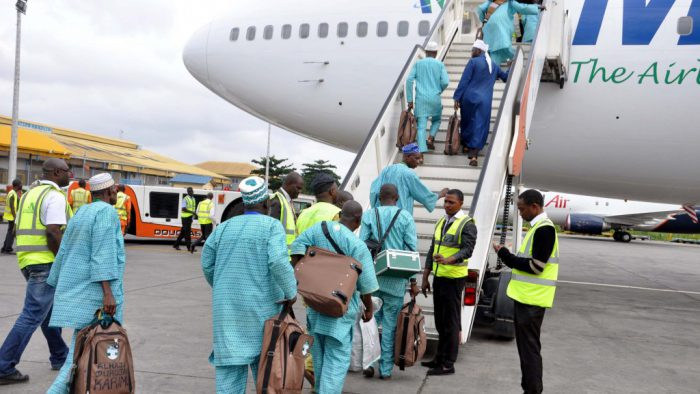

Stakeholders in Nigeria’s aviation industry have raised concerns over the escalating cost of Jet A1 fuel, warning that the development could significantly disrupt the planned airlift of pilgrims for the 2026 Hajj to Saudi Arabia.
Under the aegis of the Concerned Aviation Stakeholders, industry players called on federal and state governments to urgently intervene, as domestic airlines begin to scale down operations amid the worsening fuel crisis.
In a statement on Sunday, the group’s president, Bukalti Usaman Gamawa, said the sharp increase in aviation fuel prices poses a major threat to the logistics and financial viability of the Hajj exercise.
“Many of the airlines contracted for the 2026 Hajj operations are expected to lease aircraft to meet capacity demands. With the current fuel price increase on both legs, much of their projected profit margin has already been wiped out.
“In some cases, airlines may end up operating at break-even or even at a loss, effectively flying for free after covering lease and operational expenses. If urgent action is not taken, some airlines may find it financially impossible to commence operations from Nigeria or sustain return operations from Saudi Arabia,” he said.
Gamawa noted that although governments no longer subsidise Hajj operations, urgent policy measures may be required to avert a breakdown in the system, including pricing regulation, foreign exchange support, or strategic fuel supply arrangements.
He warned that failure to act swiftly could lead to unprecedented fare increases or, in extreme cases, operational collapse.
“In simple terms, the soaring cost of Jet A1 on both the Nigerian and Saudi sides is the clearest reason why Hajj fares are expected to rise sharply in 2026. When Hajj contracts were negotiated and signed, Jet A1 was selling at approximately ₦1,000 per litre in Nigeria, while the average price on the Saudi side was around $0.68 per litre.
“Airlines structured their fares, logistics, and operational plans around these benchmarks. Today, however, the situation has changed dramatically… Jet A1 is now being sold for as much as ₦3,000 per litre, representing a 200 per cent increase from the original price used in contract projections,” he said.
According to him, the surge has placed airlines in a difficult position, forcing a choice between absorbing losses or passing costs to pilgrims.
“If airlines are forced to absorb the increased fuel cost, many may operate at a loss. If pilgrims are made to absorb it, Hajj fares will rise sharply. If government intervenes, it may require emergency support mechanisms despite the removal of Hajj subsidies in Nigeria,” he added.
Gamawa further illustrated the scale of the challenge, noting that a single aircraft consumes about 70,000 litres of fuel per trip, with costs rising sharply under current pricing.
“Even if the Nigerian government or local suppliers stabilise Jet A1 prices for the first leg of the Hajj operation from Nigeria to Jeddah or Medina, the second phase — the return flight from Jeddah to Nigeria — remains a major unresolved challenge.
“The price of Jet A1 on the Saudi side has reportedly risen from around $0.68 per litre at the time the Hajj contract was signed to approximately $1.40 per litre…
“For airlines, this creates a double burden: Outbound leg — high fuel cost in Nigeria… Inbound leg — high fuel cost in Saudi Arabia in US dollars,” he said.
He stressed that unlike Nigeria, where intervention may be possible through policy or local supply arrangements, airlines operating return flights must purchase fuel abroad at prevailing international rates.
Stakeholders warned that without coordinated and urgent intervention from government, regulators, and industry players, the 2026 Hajj airlift could face severe disruption.