


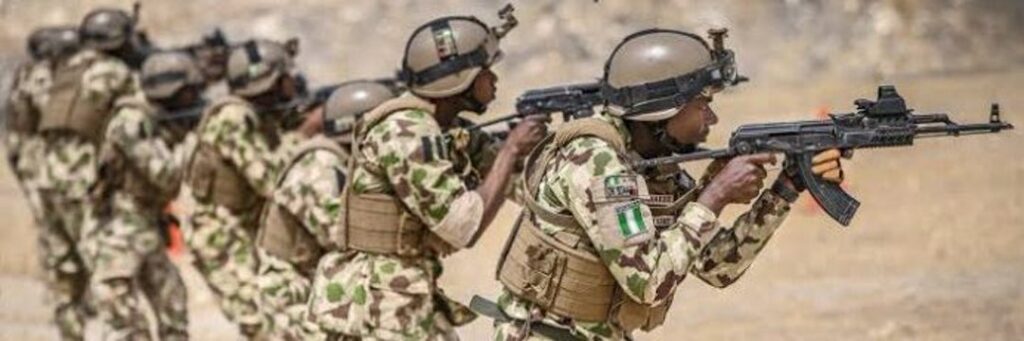


Fresh documents from the Federation Account Allocation Committee (FAAC) have shed light on how the Federal Government channelled a massive N2.3 trillion to military and paramilitary agencies over a 23-month period, raising new questions over transparency and impact.
The records, sourced by PUNCH from the Office of the Accountant-General of the Federation, show that the funds were disbursed in 23 equal tranches of N100 billion each between October 2023 and September 2025 under a special intervention arrangement.
According to the ledger titled “Ledger of Special Intervention Programme for Nigerian Military February, 2026,” each inflow into the account was immediately paid out, effectively operating as a pass-through system with no retained balance.
The document shows that the programme began with a brought-forward balance of N100 billion on October 19, 2023, alongside the first entry, “Transfer from September, 2023 Allocation 1/10,” also valued at N100 billion. Payments followed in quick succession, establishing a pattern that continued throughout the life of the programme.
From the third tranche onward, the scope of beneficiaries expanded from the military alone to “Military and Para Military Agencies,” with funds consistently disbursed within days of receipt.
The intervention was executed in phases, with the first and second phases accounting for N1 trillion each across 10 tranches apiece, covering allocations from September 2023 to April 2025. A third phase added N300 billion through three additional tranches, bringing the cumulative total to N2.3 trillion.
Despite the scale and consistency of the funding, the documents did not provide details on how the money was distributed among the various security agencies or the specific operations and projects it was meant to support.
READ ALSO: US Delivers Fresh Military Supplies to Nigeria
The records underscore the emergence of the intervention as a major off-cycle financing channel for security agencies, running parallel to statutory monthly allocations.
In a related entry, the documents also revealed that the Federal Government released N450 billion for military and paramilitary non-regular allowances within a three-month window in 2025.
Under a separate ledger titled “Ledger of Savings on Part Funding of Military and Para Military Non-Regular Allowances,” the funds were disbursed in three tranches of N150 billion each for April, May, and June 2025.
Each tranche followed the same pattern—received and fully transferred to a sub-recurrent account within days—highlighting a broader system of rapid disbursement for security-related spending.
Further entries showed that an additional N40 billion was released for security funding in September 2025 through the Office of the National Security Adviser, recorded as “First tranche of Funding Security: August, 2025.” The amount was also paid out in full before the end of the month.
The pattern, consistent across multiple ledgers, reflects a funding model where allocations are quickly routed to security agencies for operational use, but with limited public detail on utilisation.
The scale of spending comes at a time when insecurity remains a dominant concern for businesses and economic activity.
Findings from the Central Bank of Nigeria’s Business Expectations Survey for February 2026 ranked insecurity as the top constraint to business operations, ahead of taxation, power supply, and financing costs.
“Respondents identified Insecurity (71.1), High/Multiple Taxes (70.7), Insufficient Power Supply (70.0), High Interest Rate (68.6), and High Bank Charges (65.5) as the top five (5) business constraints in February 2026, highlighting factors that directly impact on operational stability and profitability.”