


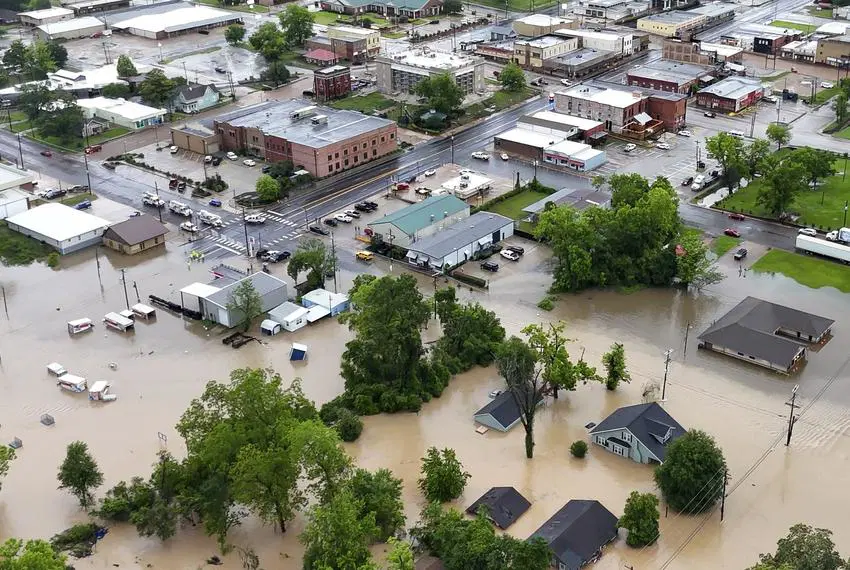


The Federal Government has warned that at least 33 states and the Federal Capital Territory will experience varying degrees of flooding in 2026, with Bayelsa, Delta, Adamawa and Kebbi among the worst-hit.
The alert was contained in the 2026 Annual Flood Outlook (AFO) released on Wednesday by the Nigeria Hydrological Services Agency in Abuja.
Minister of Water Resources and Sanitation, Joseph Utsev, who presented the report, said 14,118 communities across 266 local government areas fall within high-risk flood zones nationwide.
“The 2026 flood forecast presented today provides us with the following general highlights: High Flood Risk: 14,118 communities in 266 Local Government Areas (LGAs) in 33 States and FCT fall within the high flood risk areas,” he said.
Utsev added that a further 15,597 communities in 405 LGAs across 35 states would face moderate flooding, while 923 communities in 77 LGAs are projected to experience low flood incidents.
He warned that major cities would also be affected by flash and urban flooding due to heavy rainfall, poor drainage systems and weak flood control infrastructure.
“Flash and urban flooding are projected in major cities in the country due to high rainfall intensities, low attention to management of water facilities including drainage systems, waterways and lack of flood resilience structures,” he said.
Coastal and riverine flooding is also expected in states such as Bayelsa, Cross River, Delta, Lagos, Ogun, Rivers and Ondo due to rising sea levels and tidal surges.
“Bayelsa, Cross River, Delta, Lagos, Ogun, Rivers and Ondo are to experience coastal flooding due to rise in sea level and tidal surge and this would impact on fishing, wildlife habitation and river navigation,” the minister added.
Utsev emphasised that the flood outlook should serve as an early warning and a call to action for all levels of government and communities.
READ ALSO: iPhone 17 Pro Max Sells Out Worldwide, as counterfeits Flood Nigerian Markets
“AFO is therefore not just a scientific report, it is a call to action by all in terms of preparation ahead of the flood season, as early information saves lives, livelihoods, protects infrastructure, and reduces economic losses,” he said.
He, however, cautioned that forecasts alone would not be effective without practical action at the grassroots level, noting that the ministry is working with relevant agencies to mitigate potential impacts.
The minister also highlighted ongoing collaboration with the Nigerian Meteorological Agency to improve the integration of weather and water data for more accurate forecasting.
“As we transition toward a water-based economy, we must recognize that water security is national security. Effective water governance will play a critical role in ensuring food security, supporting economic diversification, and improving the overall well-being of our citizens,” he said.
Utsev called on state governments, local authorities, farmers and community leaders to study the report and take proactive measures, including improved land-use planning and drainage systems.
“I therefore call on state governments, local authorities, disaster management agencies, farmers, and community leaders to carefully study the findings and advisories contained in this document and take the necessary steps to prepare for the coming flood season,” he added.
Director-General of NiHSA, Umar Ibrahim Mohammed, said the 2026 outlook represents an upgrade from traditional forecasting models, incorporating hybrid AI-driven systems to improve accuracy and response time.
“The AFO has evolved into an important national planning instrument that provides early scientific prediction of flood risks in the country, evidence-based guide for decision-makers and platform for emergency coordination among stakeholders,” he said.
He added that the agency has also enhanced its flood dashboard into a real-time decision-support system, alongside a mobile application to improve public access to flood alerts.
In a goodwill message, Director-General of NiMet, Charles Anosike, acknowledged the devastating impact of flooding across Nigeria and Africa, stressing the importance of technological tools in mitigating disasters.
He reaffirmed collaboration between NiMet and NiHSA, noting that both agencies would continue to work together to strengthen flood prediction and management nationwide.